

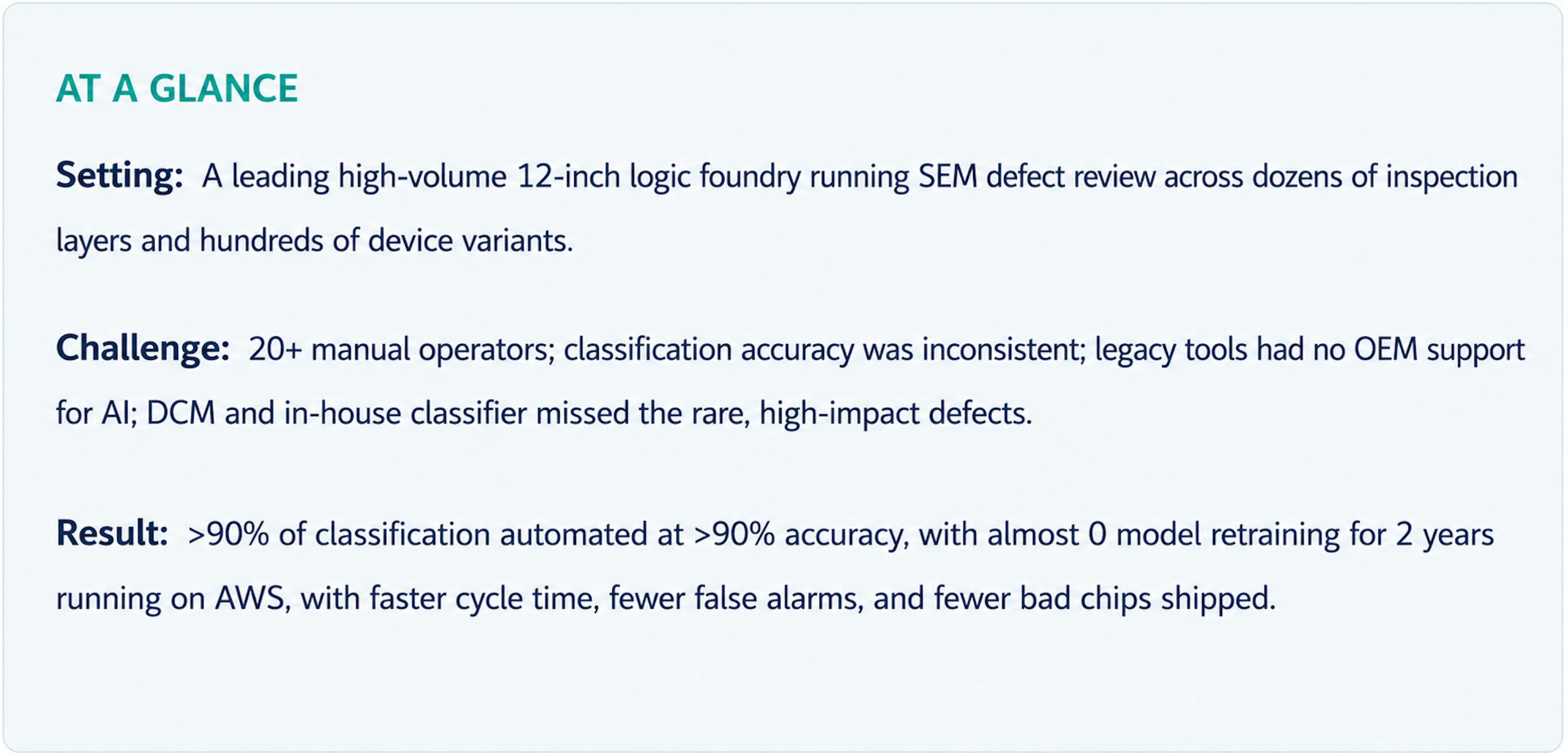
A leading 12-inch logic foundry runs scanning-electron-microscope (SEM) review at scale. On every shift, inspection tools capture large volumes of defect images, often several SEM views and an optical image per defect. Before engineers can dispose of a wafer or respond to an excursion, every one of those images has to be classified into the right defect type.
In this fab the bottleneck was not inspection from AOI, it was defect classification. This case study describes how the fab moved that work from manual review to AI-based Automated Defect Classification (AI-ADC) with SixSense, running on AWS and integrated into the fab's existing tools and KLARF flow.
The Challenge
1. Manual review could not keep pace
The fab ran SEM classification with a team of more than 20 operators reviewing images. Three problems came with that:
- Skilled inspectors are hard to find and keep: Every new hire has to be trained to a high standard which takes time, and many times comes with experience. Shortage of skilled people makes this even harder.
- Manual review becomes the bottleneck: Wafers wait for manual review which adds wafer hold time and stretches cycle time.
- People are inconsistent. On a controlled 1,000-wafer benchmark across multiple layers and nodes, operators were correct <75% of the time on average and two operators often labelled the same defect differently, so the data feeding every downstream decision could not be fully trusted.
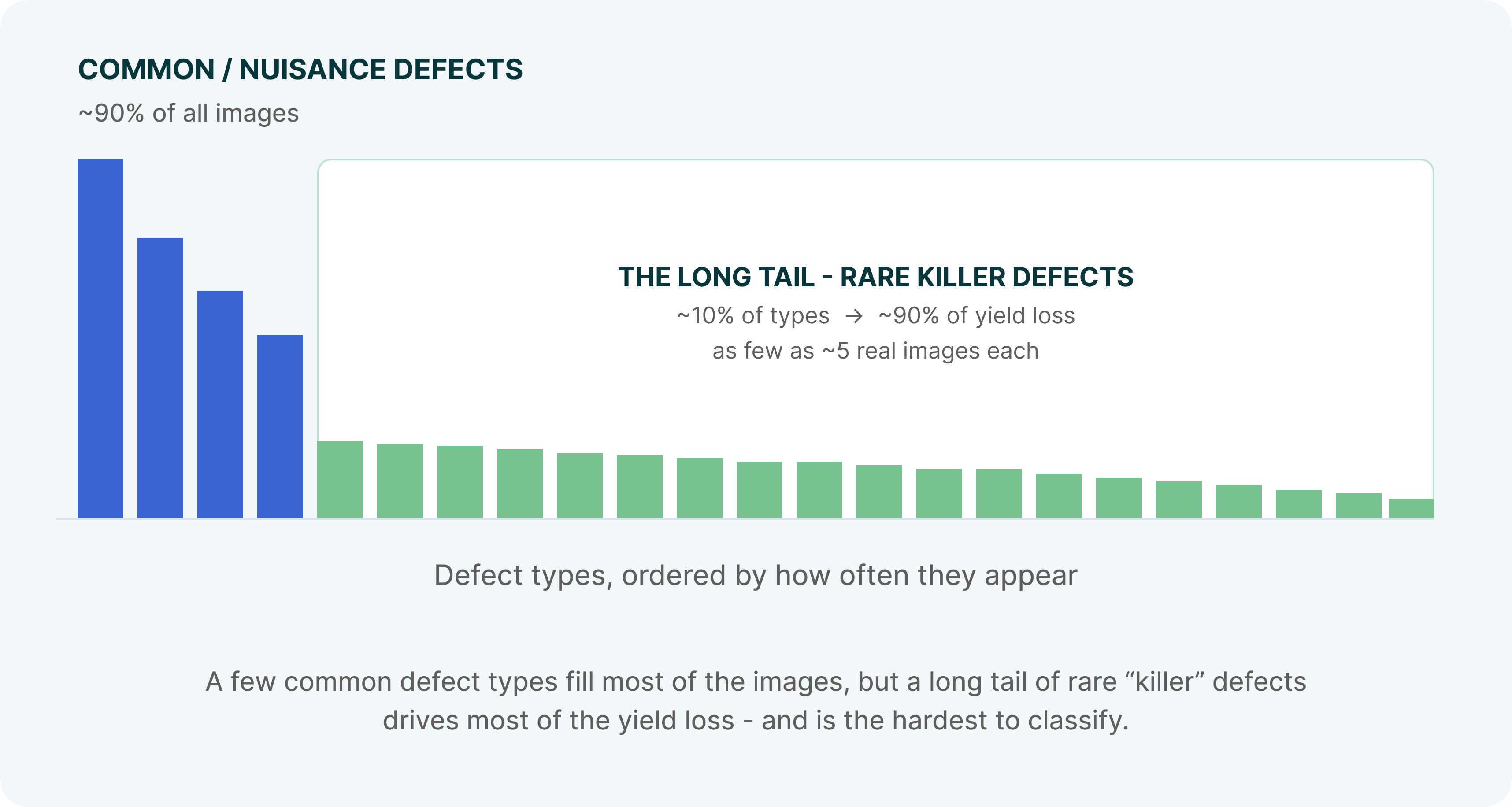
2. The most critical defects are many times rare, with insufficient samples
The defects that cause the most yield loss are the rarest. A handful of defect types such as arc scratches, embedded bridges, killer particles account for the majority of real damage, yet each may show up only a few times. This long tail is exactly where traditional ADC under performs because there is not enough history to learn from. As new devices keep getting added to the mix, this problem only increases over time.
3. Legacy & mixed tools were not supported by OEMs
Like most high-volume fabs, this one runs a mix of inspection-tool generations, including legacy tools on which equipment makers no longer support modern classification software. Those tools still produce critical data, but they had been left out of the automation plan. Replacing the hardware was not realistic since it was quite expensive.
4. Challenging for OEM and in-house tools to meet high standards of accuracy
The fab evaluated alternatives, but each of them had some performance limitations:
- The in-house AI operated below 80% all-class accuracy on rare and look-alike defects, They were able to achieve ~90% overall accuracy, but not on each class, and many times those low accuracy classes contributed to a big chunk of excursions/ yield loss.
- OEM classification software is tied to its own tool. But a single defect is often visible across both SEM and optical tools, so software that sees only its own tool's data lets those cross-tool defects escape.
- Using 7+ defect views to achieve 90% + accuracy: One view rarely carries enough information to tell similar defects apart, no matter how good the model is. And building an engine that could take top views, side views, different FOVs, wafer maps, optical images all into account together to make a decision had never been built.
The SixSense Solution
1. 7+ images reviewed together: accuracy grows as views are added
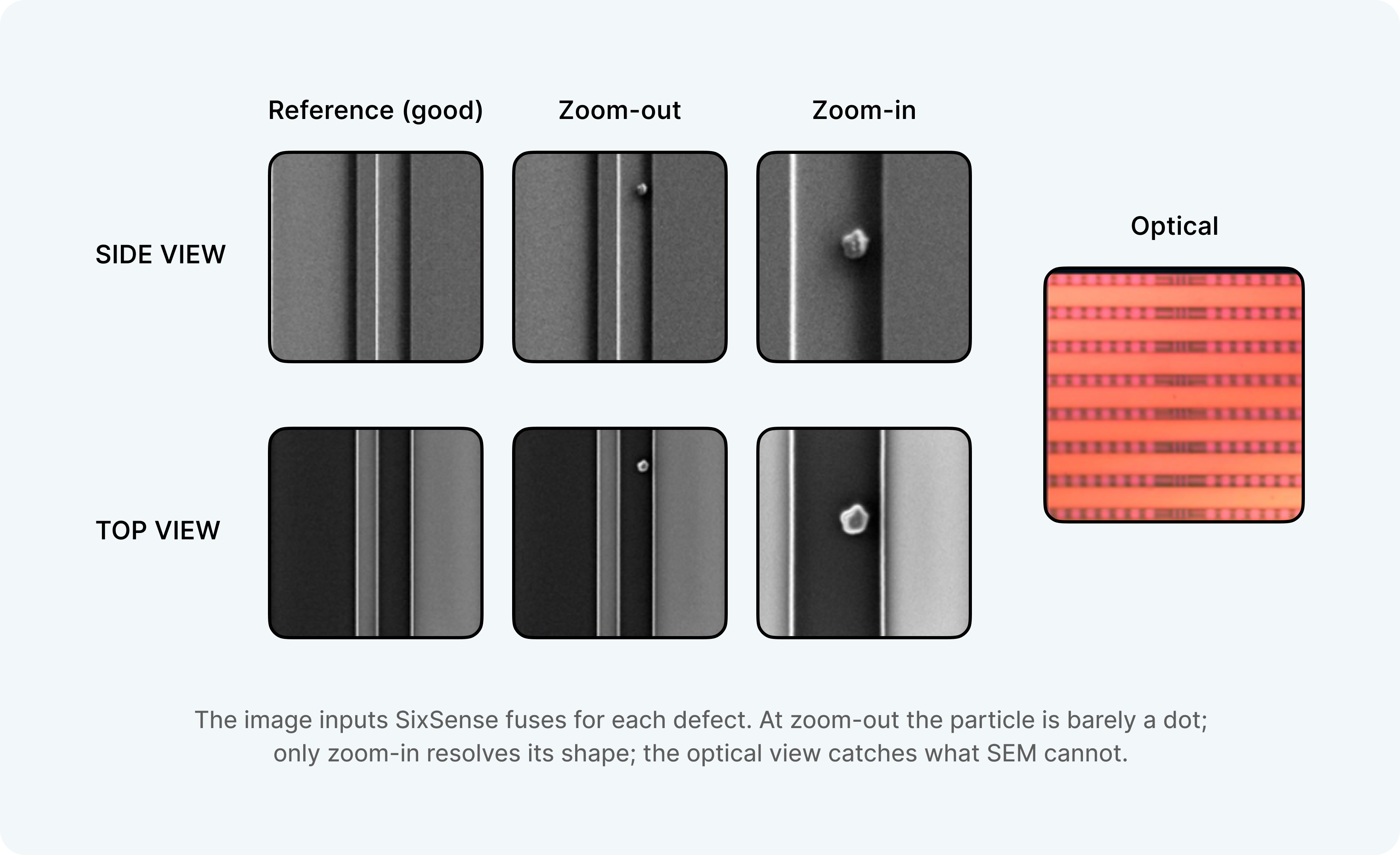
The biggest accuracy gains came from giving the model more than one view of each defect. A classifier that sees only a single zoomed-in SEM frame sits near 68-70% accuracy. Adding a known-good reference image, a zoom-out view, the wafer map, the optical image, and a top-down view lifts accuracy past 90%: a gain of more than 25%, mostly in defects that are misjudged in a single view. We believe if signals are pooled across views and magnifications, the accuracy is higher as each defect is assessed based on the view it is most clearly visible in.
The tough cases and what each view adds
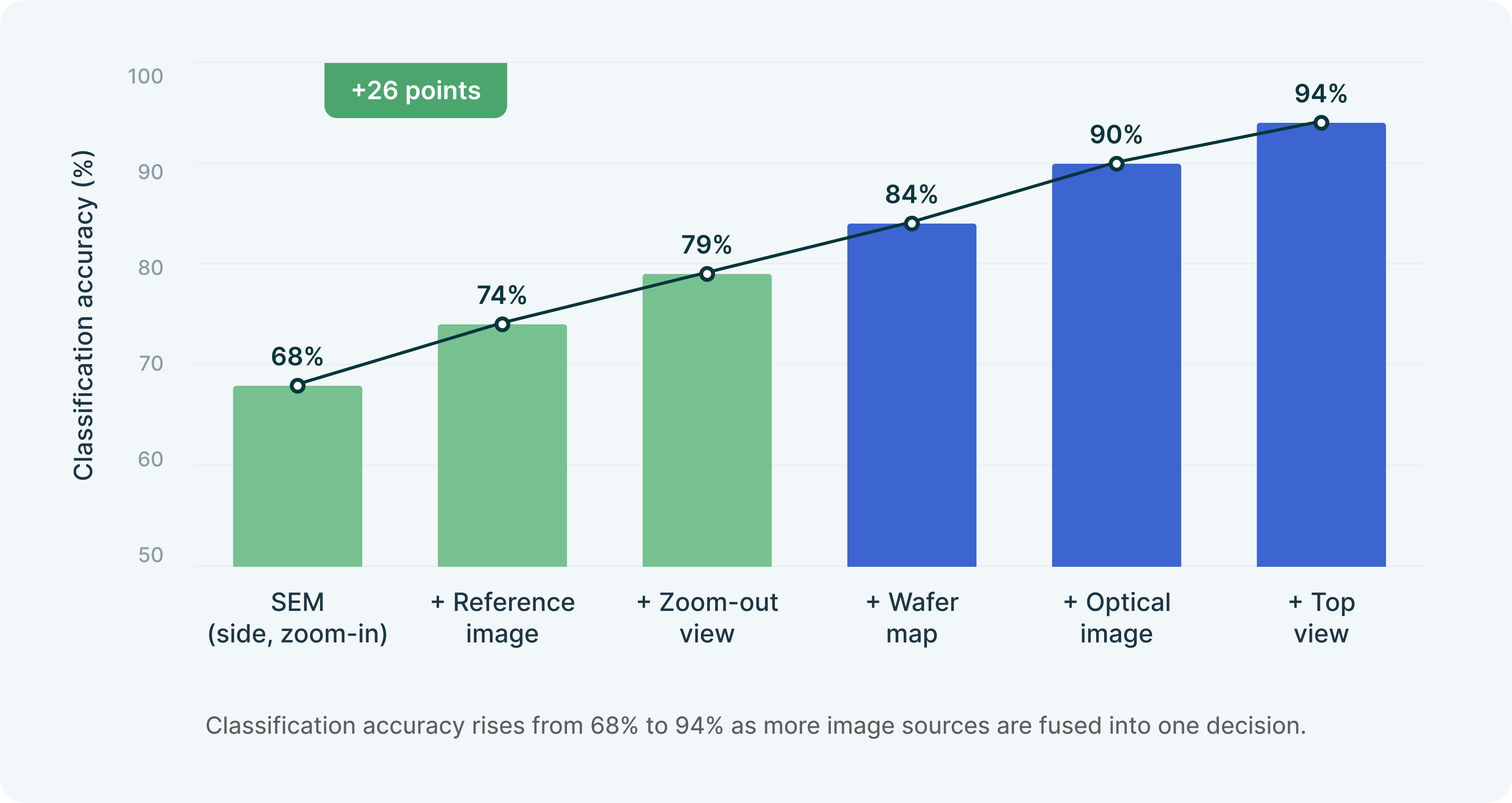
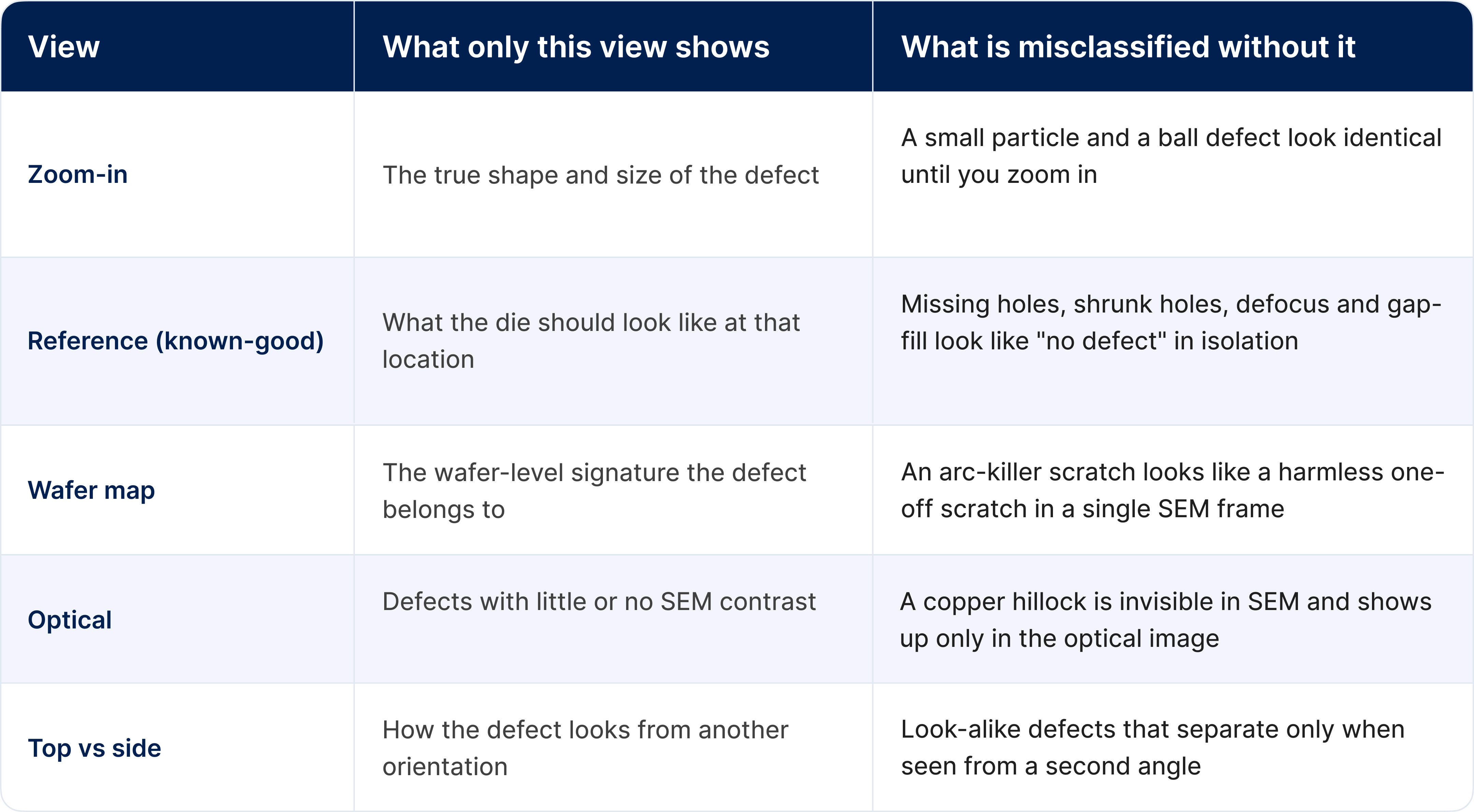
Real SEM and optical review is full of cases where one frame is not enough. SixSense ingests the full set of views for each defect: reference, zoom-out and zoom-in (side and top), plus optical and fuses them into a single classification.
The table below shows, for each view, what only that view can reveal and what gets misclassified when it is missing:
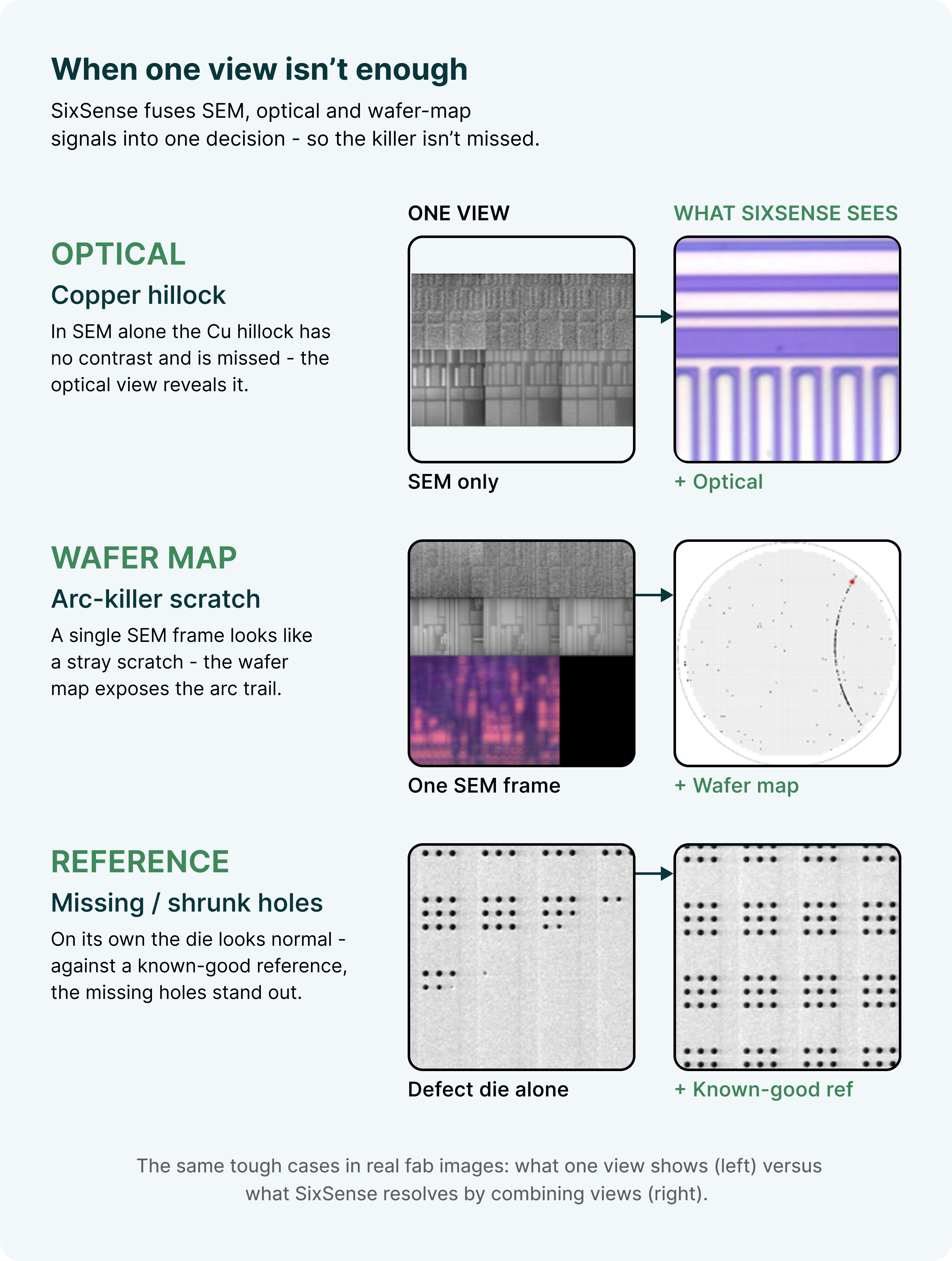
- Context decides severity. The same label “scratch” can mean a yield-killer on active metal or a harmless mark on dummy fill. SixSense reads the surrounding pattern and disposes them differently.
- When several defects share a frame, report the killer, not the largest. A thin defocus can matter more than a big, benign copper hillock sitting next to it. SixSense ranks by yield impact, not just defect size
3. One model across every tool generation including legacy tools, and across OEM tool types
SixSense models were deployed across G3-G7 AMAT tools, and included optical tools from KLA. It cuts launch effort by ~90% since each model is deployed across tool types. It also automates the legacy tools with no hardware change.
The Technology: Why It Outperforms OEM ADC
Five technology choices that allowed for high accuracy, especially on defects that matter, even across tools, and also ensure the accuracy stays high over time:
WHAT MAKES IT DIFFERENT
1. Foundation model: pre-trained on millions of images; separates look-alikes and learns a new class from a handful of examples.
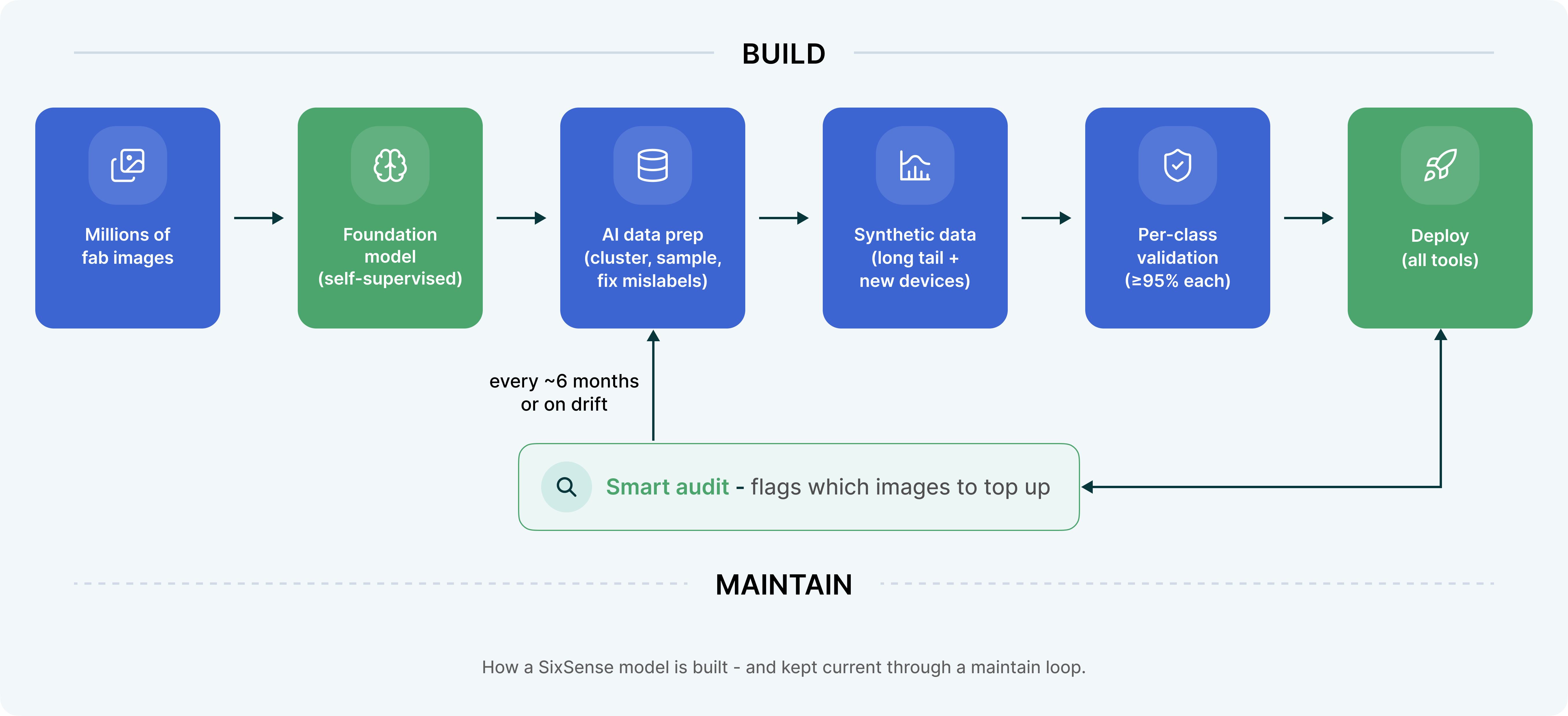
2. AI-assisted data prep: auto-selects the right ~200 images per class for training and flags which images to top up to keep models updated.
3. Synthetic data for the long tail defects: rare killers and new device variants reach accuracy without waiting a quarter for data.
4. Per-class accuracy ≥95%: escape and false-alarm rates tracked per class, not overlooked by overall accuracy.
5. Explainable: heatmaps so engineers can trust and explain every classification.
1. A Fab’s foundation model
SixSense models start from a foundation model self-supervised on millions of fab images. Some of the key benefits of foundations models seen in Fab use cases are following:
1. Start from unlabelled images: In many cases, the customers used the foundation model to group unlabelled images of defects together into clusters. This especially helped when a big chunk of images was unlabelled, and pre-trained models helped in sorting images by assessing similarity between defect images.
2. Learn from minimal images: These models already understand the full visual world of the fab from prior experience, and are able to extract defect specific features with minimal images.
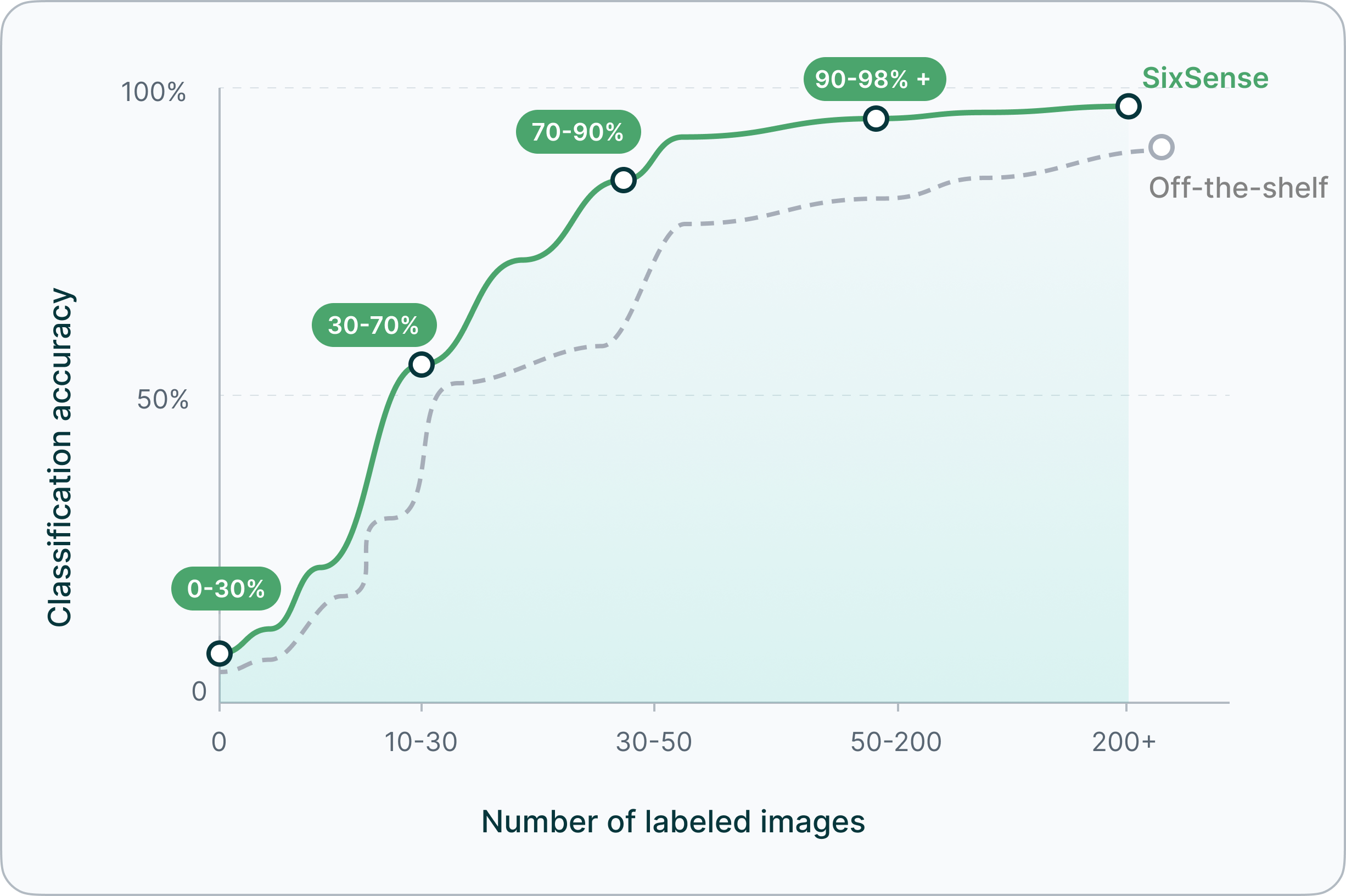
3. Higher accuracy, lower escape/overkill: The foundation model also preserves nuanced details that differentiate very similar looking defects. e.g. a spin line versus an ordinary line, a killer scratch versus a benign one raising the bar of performance as compared to an off the shelf model.
2. AI-assisted data prep — train on the right data, not more data
Typical problem with traditional ADC
1. Capturing all defect variety in model training manually is impossible: In fabs, each defect can manifest in multiple sizes, locations, and visual characteristics. Ideally, fabs have millions of historical images and variety across defects, but when it comes to building a model, it's almost impossible to scan through millions of images and ensure visual variety within each class is well represented.
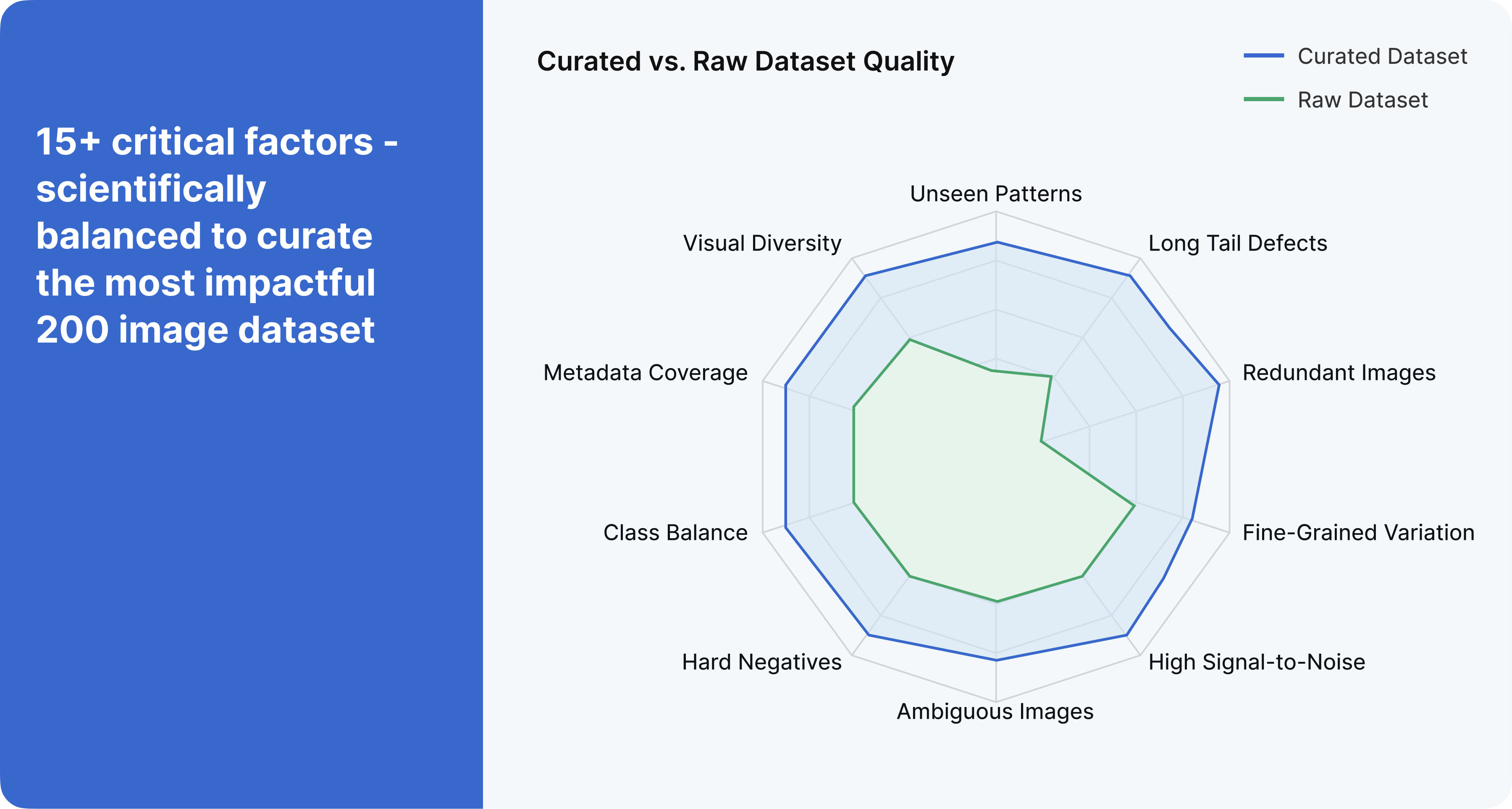
2. Accuracy drops in production & models require frequent retraining: If engineers select too many images, it becomes hard to review and ensure label consistency. If they select too few, they end up retraining the model frequently after releasing to production as the accuracy in production does not match the accuracy at the time of launch.
SixSense solution: From the fab's image history of millions of images, it runs intelligent variety sampling to pick ~200 informative images per class balanced across 15+ factors (visual diversity, class balance, boundary cases, long-tail coverage, signal-to-noise, hard negatives). This ensures coverage of defect variety while preparing the model.
The tool also surfaces mislabels in the overlap regions for quick correction. Engineers reach a target accuracy with fewer than 200 images in 2–3 iterations and the same engine, in production, flags exactly which new images to add to keep a model updated.
3. Synthetic data for the long tail and new device variants
Rare killer classes may have only ~5-10 real images, and every new device variant adds more to the long tail. With under 20 samples, SixSense generates targeted synthetic examples (~10x) including new backgrounds and new device variants for about 25× better stability in high-mix environments. This is how rare, high-impact classes reach production accuracy without waiting a quarter to collect data.
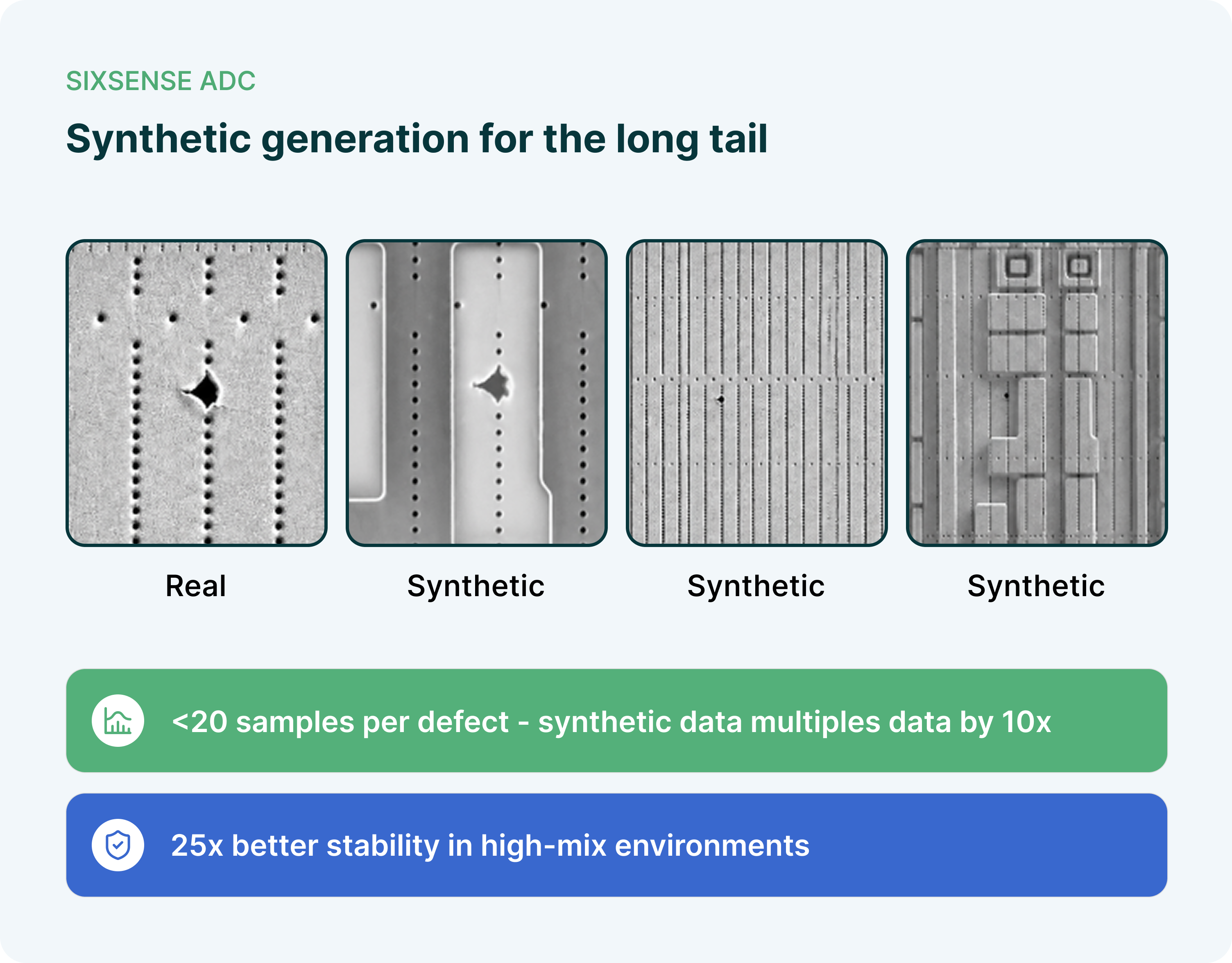
4. Accuracy per class, not just on average
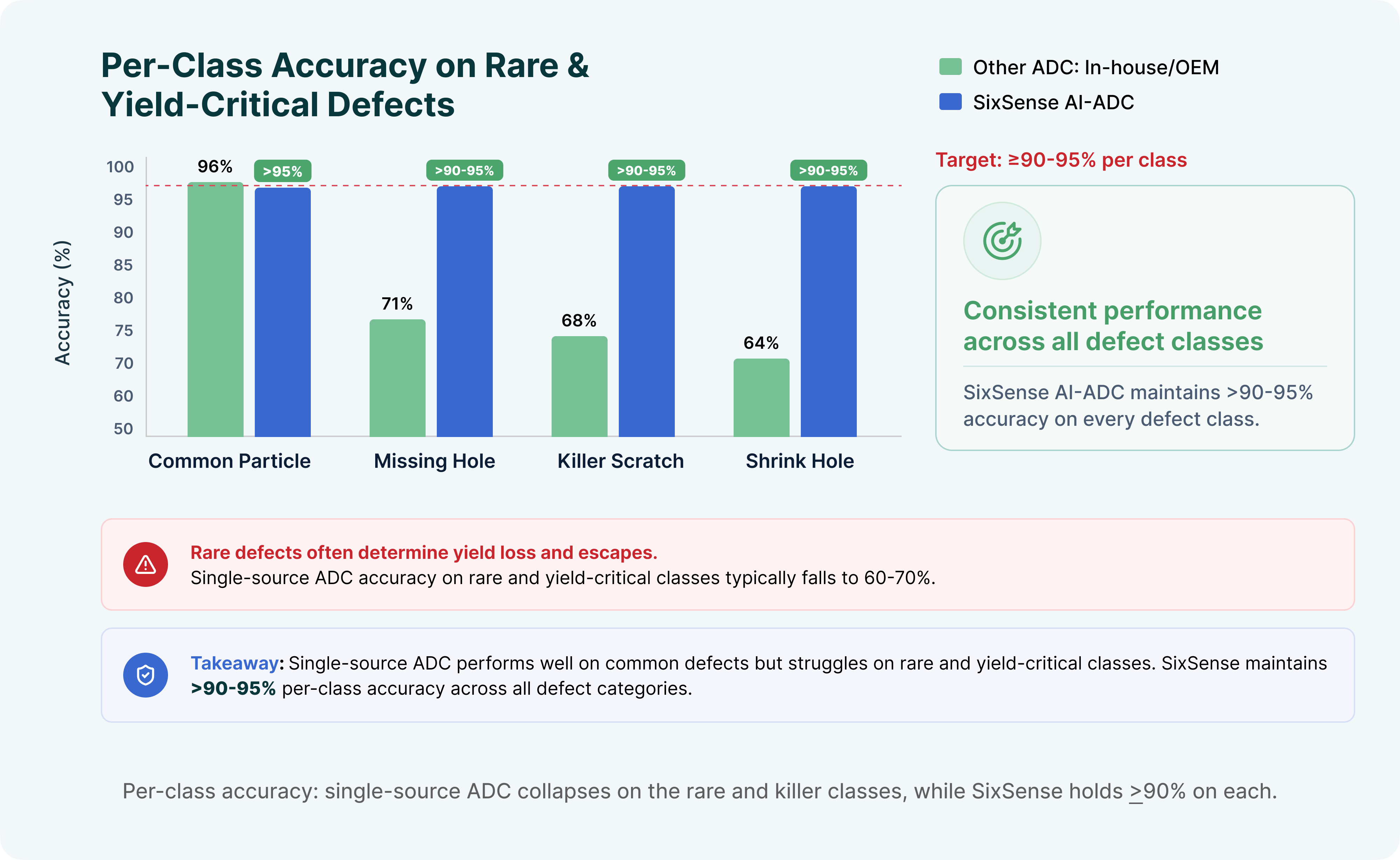
A 90% overall accuracy hides the performance on classes that sometimes matter most. Traditional ADCs are usually at 60–70% on killer scratches, missing and shrink holes, and other rare or look-alike classes. SixSense targets ≥90% on every class and tracks escape and false-alarm rates per class, so weak classes get focused training instead of being overlooked by averaged accuracy.
5. Explainable, not a black box
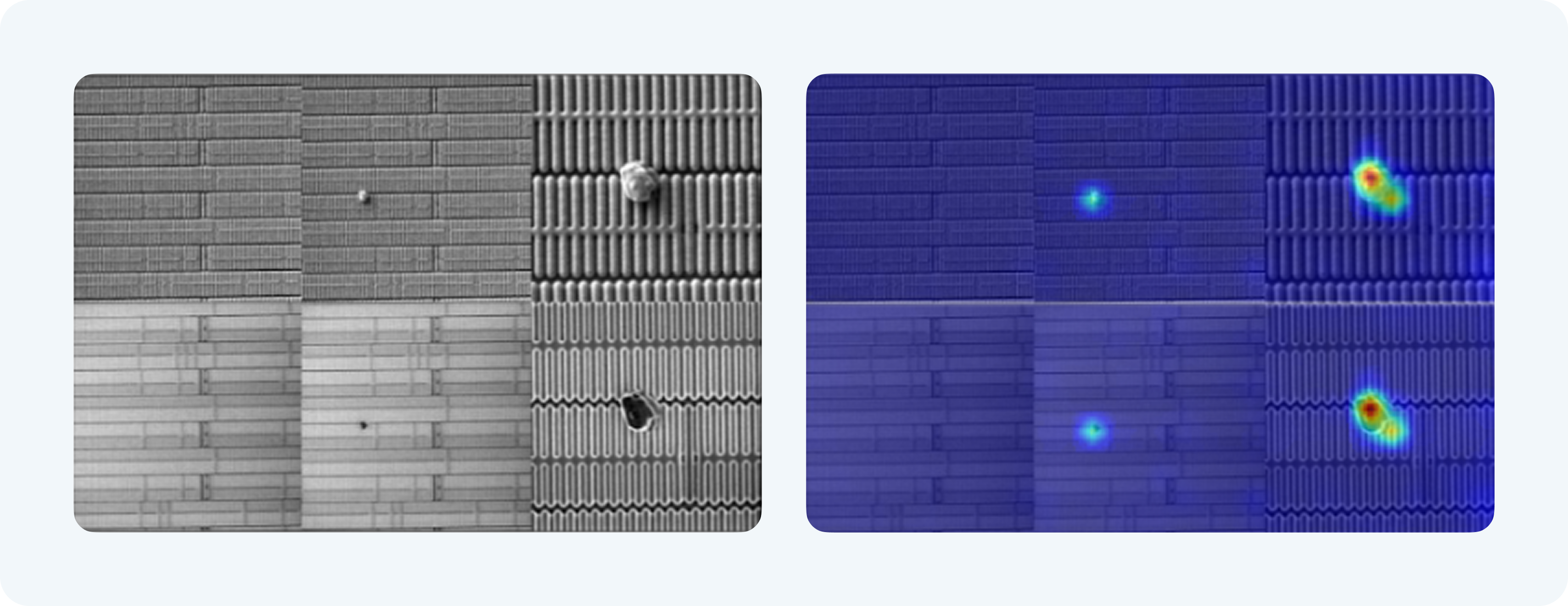
Every classification comes with a heatmap showing which pixels drove the decision, so a yield engineer can verify and defend a classification instantly.
How It Fits the Fab's Existing Systems
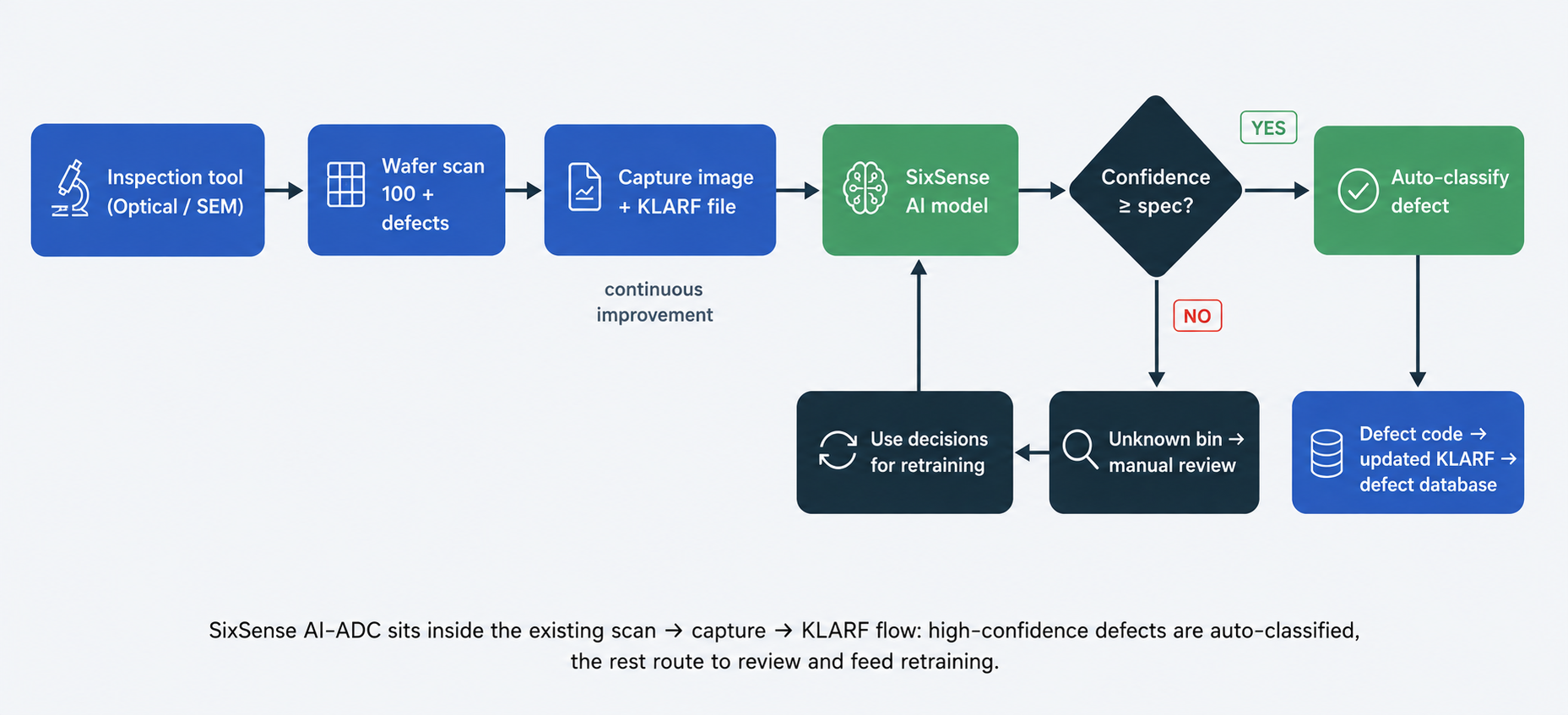
AI-ADC is integrated across the major optical and SEM inspection platforms in the line, reads and writes the same KLARF files the tools already produce, and works alongside the existing DMS systems (Standard or In-house) so results appear exactly where engineers expect them, with no change to how people work.
The flow is simple. When a recipe is AI-enabled, the defect image, wafer information, and KLARF file go to the deployed model. If the model's similarity score w.r.t training data is above a set threshold, the defect is auto-classified and a defect code is written back into an updated KLARF file. If confidence is below threshold, the image is routed to an “unknown” bin for a quick manual check and those human decisions are fed back to keep the model improving.
The fab can also choose to automatically ‘reject’ the unknown images, and avoid holding the wafer/ lot for review. This helps to ensure most of the wafers are auto-checkout. Only if the wafer has a high percentage of ‘ new defects’ , is it held for manual review.
When AI-ADC is connected to AI- RCA, the system becomes much more powerful. Now it has an automated feedback loop that determines which classes are most essential for RCA, if there are any new defects, or if some classes need to be split since they indicate 2 different root causes.
Deployed at Scale
The system runs across the fab's production layers, spanning front-end-of-line steps (such as poly and non-volatile-memory layers) and back-end-of-line steps (film, CMP, via, and trench layers), across hundreds of device variants. A few things to note at that scale:
- Engineers launch their own models in 2–3 days. A yield or integration engineer, not a data scientist, connects the historical image database and the system auto-selects ~200 informative images per class, without having to hunt through thousands of images; and most models therefore stabilize in 2–3 iterations.
- Only the uncertain cases reach a person. With >90% automation, operators review just the low-confidence and unknown-bin images — and those reviews automatically feed retraining.
- Drifts due to new defects are proactively highlighted. Smart-sampled audits check model performance continuously, and genuinely new or unknown patterns are flagged for review rather than silently forced into an existing class.
- Latency is under a minute per wafer, so classification keeps pace with the line and disposition is not held waiting on review.
Results
Measured on the 1,000-wafer benchmark and confirmed in production:
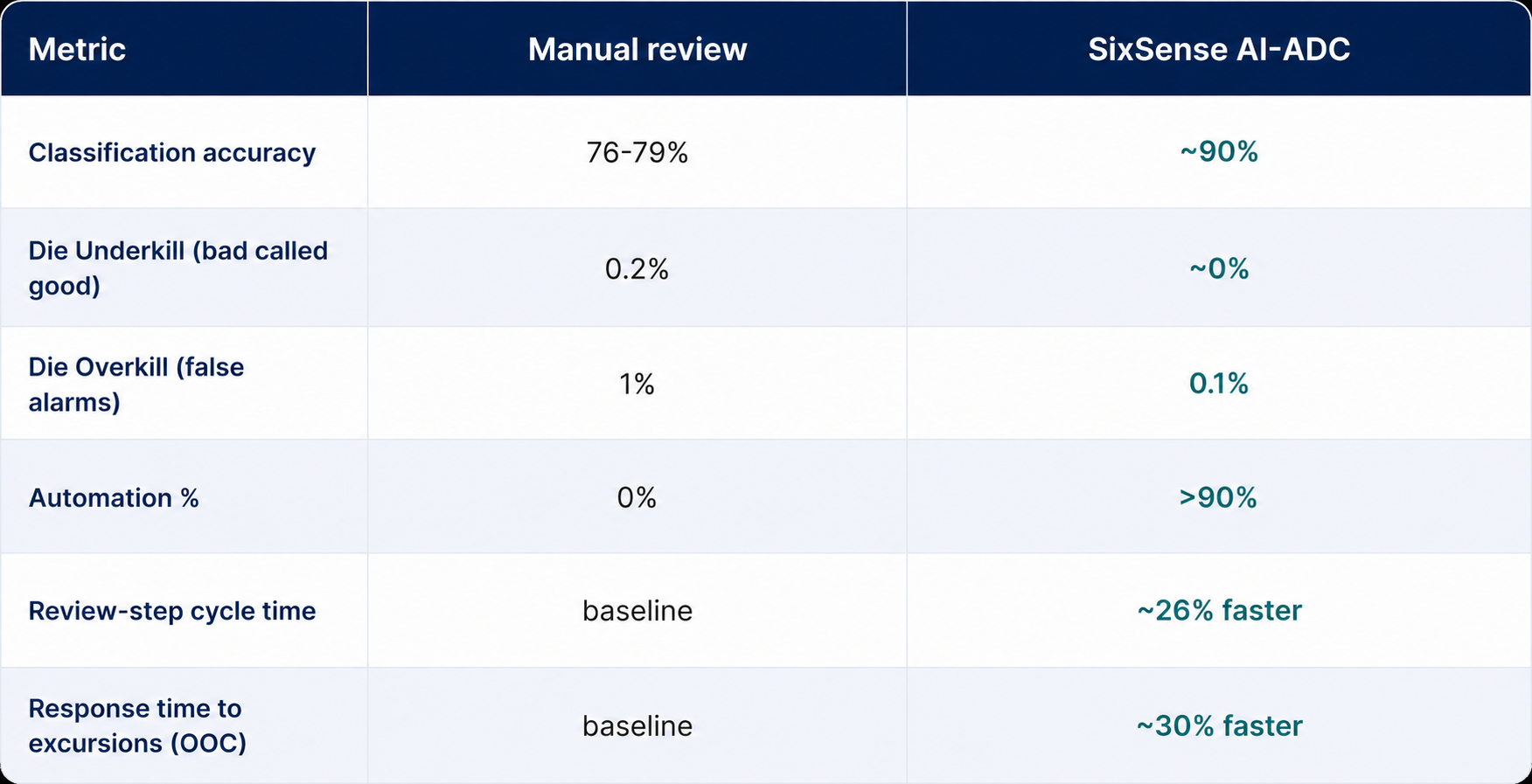
Lower underkill means fewer critical issues get overlooked and faster containment of yield-loss causing problems; lower overkill means fewer good wafers held for no reason and less false alarms for engineers to investigate . Both feed straight into higher yield, quality and productivity.
Built to Stay Accurate Over 1–2 Years
A common worry with fab AI is that accuracy quietly decays in production. Here it did not. A review of every model deployed since the program began found them still running at about 90% automation and >90% accuracy after nearly one to two years in production without retraining — a direct benefit of the auditing and maintenance capabilities.
Deployment, Reliability, and Data Security
SixSense runs on AWS as well as On-premise, depending on customer preference. Cloud lets the fab adopt and operate AI reliably at production scale without taking on an infrastructure overhead.
Deploy in days, with flexible data handling
Because the platform is cloud-hosted, the fab deployed in days, with no GPU hardware to procure or manage. Whenever the load increases, the capacity is increased with a few clicks, without long hardware procurement cycles.
Always-current hardware, no refresh cycles
On-premises GPUs age quickly and cap performance. On AWS, SixSense moves to newer GPU generations every 12–18 months, so models train faster and inference stays efficient and the fab benefits immediately, without additional investment into new hardware.
Production reliability built in
Manufacturing cannot tolerate downtime. The architecture delivers 99.97% uptime and is fault-tolerant by design: auto-recovering services, a queue that ensures no inspection data is lost, high-availability storage across zones, and stable, low-latency inference. Model updates deploy in minutes, not weeks, without disrupting production.
Elastic scale, no GPU burden, cross-fab sharing
GPU capacity scales on demand — 10x or more during ramps, excursions, and retraining, then scales back. SixSense manages all drivers and dependencies, so the fab's engineers focus on defect analysis, not infrastructure. Models proven at one site can be shared securely and deployed to a new fab in days. (Specific security and compliance details such as encryption, access controls, data-residency, certifications can be tailored to the customer's policy on request.)
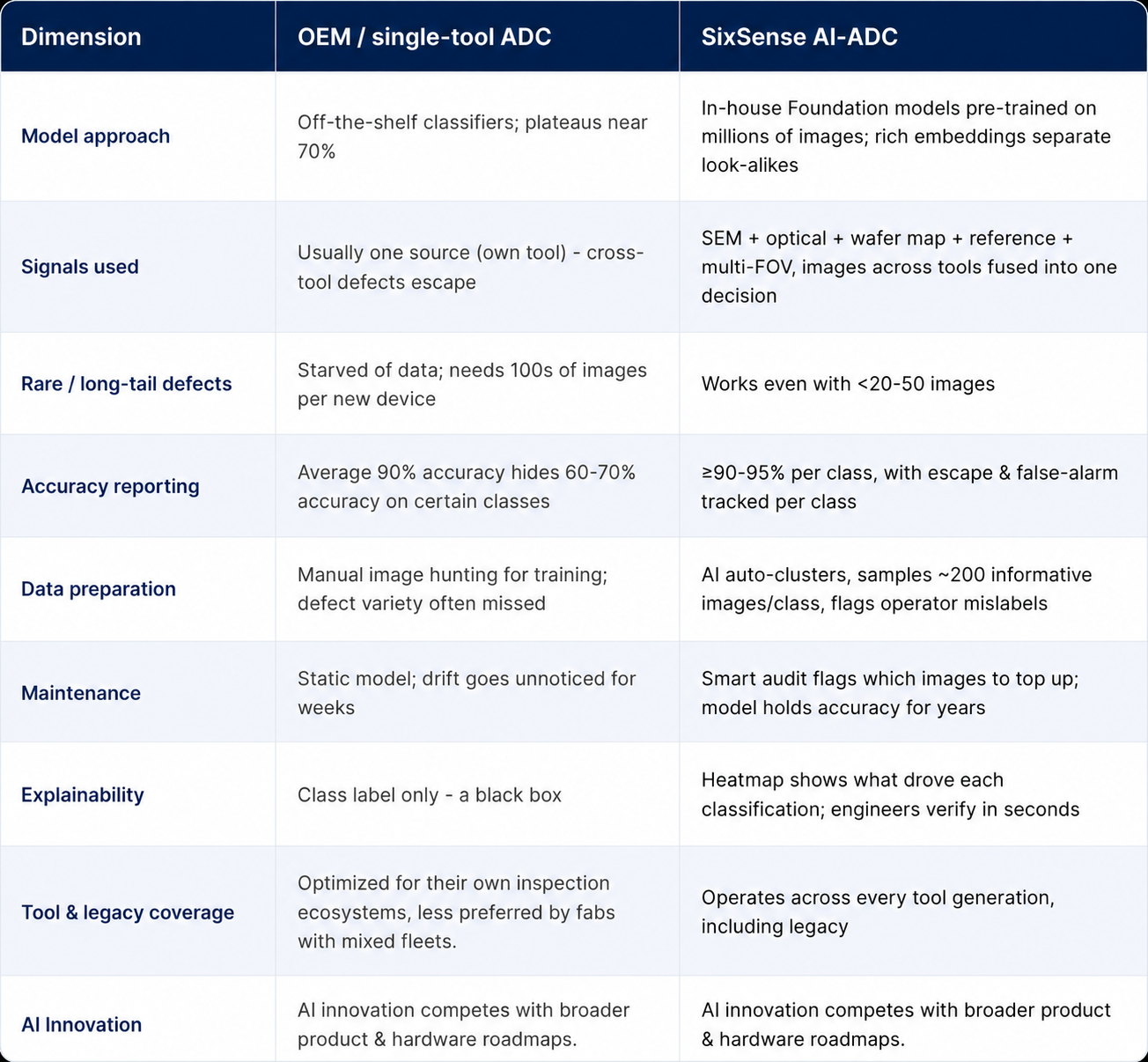
Why SixSense over OEM and In-House Options
Why It Matters
In any data-driven operation, the quality of decisions depends on the quality of the input data. Reliable defect labels are the foundation under everything downstream: trend analysis, excursion response, and the automated root-cause analysis that ties inspection results to specific tools, chambers, and steps. Accurate classification is the first layer of that stack: once defect data is trustworthy, the same platform can detect process drift early and trace deviations to their source, cutting root-cause work from weeks to hours.
By making SEM classification accurate, consistent, and fast at scale and running it reliably on AWS the fab freed skilled engineers from routine review, sped wafers through inspection, and built a dependable data foundation for the next layer of automation.
Note: The customers are anonymized at their request. Layer names are generalized to common industry process steps.