

Wednesday, 2:14 AM. Fab 12, Line 3 Control Room.
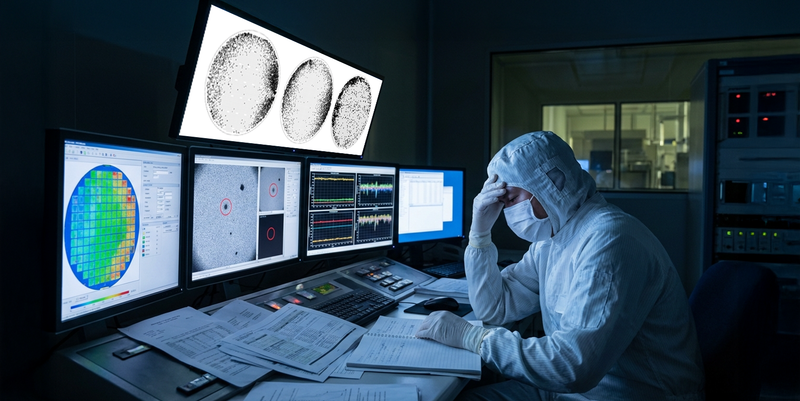
Danny Zhang pulled up his sixth database query of the night, squinting at the screen through tired eyes. The yield drop on Lot W2547 had triggered an automatic alert 4 hours ago, and he'd been chasing the root cause ever since.
The wafer maps showed an unknown pattern of failures. But he knew he'd seen this before. Maybe three months ago? Or was it six?
He opened another window and searched through the investigation archive: "edge defects", "radial pattern", "chamber B" Sixteen results. He clicked through the first report. Close, but the pattern was in the center, not in the edge. The second report was from two years ago, different tool, different process step. The third…
When Data Is Everywhere, Why Is Root Cause Still So Hard?
The aforementioned similar situation is very common. The Modern semiconductor fabs generate vast amounts of data across every stage of manufacturing, but root cause analysis is still very troublesome. Wafers are inspected repeatedly, metrology tools record detailed measurements, and probe tests produce thousands of electrical values for each Lot. This information supports daily process control and yield monitoring. Even so, when a yield excursion occurs, engineers often return to the same core question: has this issue appeared before?In many cases, the answer remains unclear. The data exists, but the experience tied to earlier problems is spread across reports, tools, and time. As patterns evolve and teams change, earlier lessons become harder to retrieve and reuse.
Detection Alone Does Not Preserve Experience
Fabs rely on multiple systems to surface abnormalities. Defect classification models identify inspection anomalies, wafer pattern recognition highlights spatial signatures, and root cause analysis methods correlate signals across tools and process steps. These systems provide visibility into current conditions and help teams respond quickly. The greater challenge appears after detection. Engineers need to understand whether a pattern represents a known issue under new conditions, whether a previous investigation reached a confirmed root cause, and whether the corrective action stabilized yield over time. These answers depend on accumulated experience, which often remains fragmented across documents, personal notes, and disconnected systems. Over time, teams revisit similar problems without access to the full investigation history.
From Data Storage to Manufacturing Memory
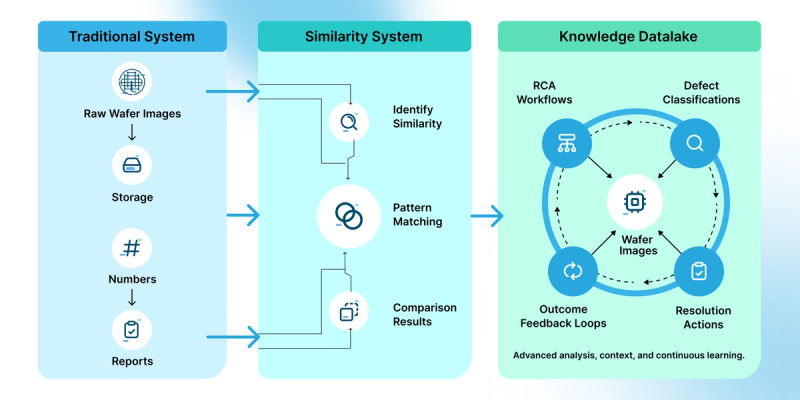
This gap points to a broader shift in how manufacturing systems are designed. Recurring yield problems benefit from being treated as accumulated experience rather than isolated data points. One emerging approach is the use of a Knowledge Datalake that brings together inspection images, wafer maps, probe data, and process context within a unified structure. Information is organized in a semantic space that supports AI-based analysis and comparison across long time horizons. Beyond storage, the datalake captures the full problem-solving process, including defect classification results, pattern clustering, tested hypotheses, confirmed root causes, corrective actions, and yield response after resolution. Over time, this structure converts raw measurements into a durable record of manufacturing experience.
Clustering plays a central role in this approach because many process issues appear as related families of patterns rather than isolated events. A spatial signature may shift gradually across Lots, a probe anomaly may repeat under specific operating conditions, or a wafer-level pattern may grow across successive runs. By grouping related behavior over time, clustering reduces the volume of information engineers must review while preserving essential context. Engineers focus on dominant pattern families, track their evolution, and recognize recurring behavior earlier in the investigation cycle.
AI Learns as Manufacturing Knowledge Accumulates
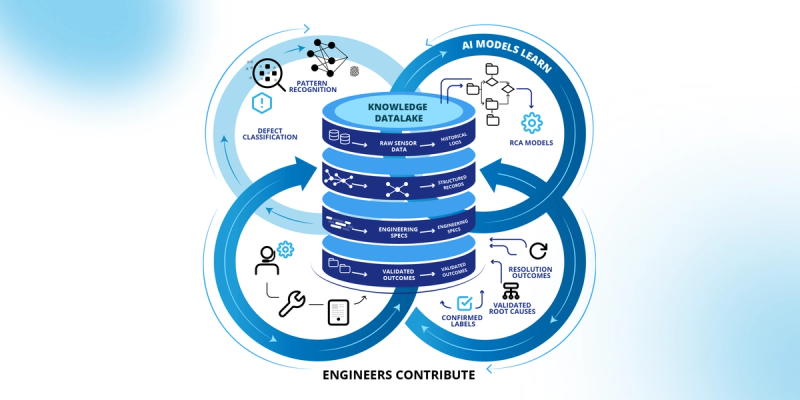
The Knowledge Data lake also serves as a foundation for continuous learning by AI models. Defect classification models retrain using confirmed labels, pattern recognition models learn from stable clusters over longer time horizons, and root cause analysis models improve by observing which correlations consistently led to confirmed conclusions. As experience accumulates, both engineers and models benefit. Model behavior becomes more stable, sensitivity to noise decreases, and recognition of rare but important failure modes improves through repeated exposure to validated cases.
This structure supports daily engineering work in practical ways. When an engineer reviews a new defect image, the system retrieves similar historical cases along with their resolution history, including the originating tool, affected process step, confirmed cause, and corrective action. When wafer maps are reviewed across multiple weeks, slow drifts that remain hidden in daily inspections become visible through long-term grouping. Over time, the Knowledge Datalake functions less like a conventional database and more like a reference library of manufacturing experience.
From Detecting Defects to Compounding Manufacturing Knowledge
As process nodes shrink and integration complexity rises, yield issues become more subtle, infrequent, and slow-moving. Their true impact often only becomes clear when viewed across: time, tools, process steps, historical investigations
In this environment, preserving experience matters as much as detecting defects. Detection surfaces the signal. Clustering organizes recurring behavior. Knowledge Datalakes retain investigation context. AI compounds learning over years.
When fabs treat experience as a core manufacturing asset, root cause analysis gains both speed and reliability, enabling stable yield improvement in an era of rising precision and complexity.
Data provides visibility. Experience provides direction. And fabs that can compound knowledge will scale with confidence.